
Appointment of CEC and EC in India: 2023 Act & Anoop Baranwal Case Explained
Can the Chief Election Commissioner be arrested? Explore a deep breakdown of the ECI appointment process under the 2023 Act, the Anoop Baranwal judgment summary, and Article 324 constitutional safeguards for UPSC Polity.
In this article (6 sections)▼
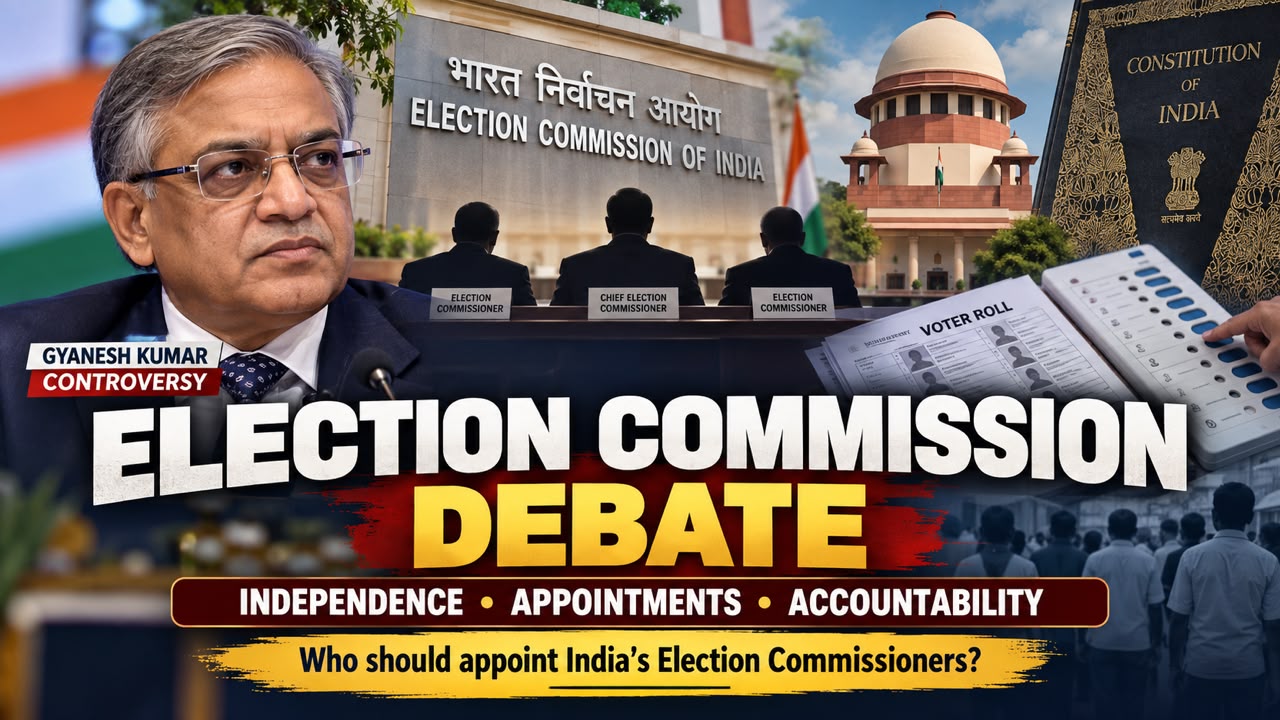
The institutional autonomy, constitutional framework, and operational mechanics of the Election Commission of India (ECI) have taken center stage in India's legal and political discourse. A series of compounding developments has transformed a long-standing academic debate into an acute constitutional issue. This makes it a critical topic for UPSC Civil Services Examination aspirants under the General Studies Paper II (Governance and Polity). Understanding how the Chief Election Commissioner (CEC) and Election Commissioners (ECs) are appointed, insulated, and protected is vital to mastering India's democratic structure.
What Does the Constitution Say About the Appointment of Election Commissioners?
The bedrock of India’s electoral governance is Article 324 of the Constitution of India. This single provision vests the "superintendence, direction and control of elections" to Parliament, state legislatures, and the offices of the President and Vice-President directly within the ECI. According to Article 324(2), the Election Commission shall consist of the Chief Election Commissioner and such number of other Election Commissioners as the President may from time to time fix. The appointment of the CEC and other ECs shall, subject to the provisions of any law made in that behalf by Parliament, be made by the President. However, for over seven decades, a crucial legislative gap existed. Parliament did not enact a specific law to formalize these appointments. Consequently, the executive branch maintained absolute discretion over selections, leading to persistent concerns regarding systemic neutrality.
The Turning Point: Why the Supreme Court Intervened
As election processes grew more complex, critics argued that a truly independent election watchdog should not be appointed solely by the ruling executive. The core legal argument pointed out a paradox: an institution tasked with conducting free and fair elections could be perceived as compromised if its leaders were chosen exclusively by the political party currently running the government. This institutional vulnerability culminated in a landmark public interest litigation (PIL) before a five-judge Constitution Bench.
The Anoop Baranwal v. Union of India Judgment Summary
In March 2023, the Supreme Court delivered its historic verdict in the Anoop Baranwal v. Union of India case. The Court ruled that absolute executive control over ECI appointments undermined the democratic ethos of the country. To rectify this legislative inertia, the Court established an interim constitutional mechanism. It declared that until Parliament enacted a valid law under Article 324(2), the President would appoint the CEC and ECs based on the binding recommendations of a tripartite selection committee.
- The Prime Minister of India (Chairperson)
- The Leader of the Opposition in the Lok Sabha (or the leader of the single largest opposition party)
- The Chief Justice of India (CJI)
The Court explicitly intended this arrangement to serve as a temporary safeguard, maintaining institutional equilibrium until the legislature stepped in to exercise its constitutional mandate.
The Chief Election Commissioner Appointment Act, 2023
Responding directly to the judicial directive, Parliament enacted the Chief Election Commissioner and Other Election Commissioners (Appointment, Conditions of Service and Term of Office) Act, 2023, which came into force in January 2024. This statute systematically established a statutory framework for ECI management, but introduced a highly debated structural composition for the selection process.
| Appointment Metric | Anoop Baranwal Judgment (Interim Framework) | CEC Appointment Act, 2023 (Current Enacted Law) |
|---|---|---|
| Panel Member 1 | Prime Minister of India | Prime Minister of India |
| Panel Member 2 | Leader of the Opposition (or largest party) | Leader of the Opposition (or largest party) |
| Panel Member 3 | Chief Justice of India | A Nominated Union Cabinet Minister |
| Search Mechanism | No formal preliminary search panel created | Five-member Search Committee headed by the Law Minister |
Constitutional Removal Process: The Structural Asymmetry
Once appointed, the operational autonomy of the commissioners hinges entirely on their protection from arbitrary executive dismissal. Here, the Constitution introduces a distinct asymmetry between the chief and the commissioners under Article 324(5). The Chief Election Commissioner is granted exceptional security of tenure. The CEC can only be removed from office "in like manner and on the like grounds as a Judge of the Supreme Court." This demands a rigorous parliamentary removal process under the Judges (Inquiry) Act, 1968, requiring an investigation into proved misbehavior or incapacity, followed by a special majority vote in both Houses of Parliament. Conversely, other Election Commissioners do not share this absolute security. The proviso to Article 324(5) dictates that an Election Commissioner cannot be removed from office except on the specific recommendation of the Chief Election Commissioner. While this shields them from direct unilateral action by the government, it establishes a clear hierarchical vulnerability within the panel.
The Legal Reality: Can a Chief Election Commissioner Be Arrested?
A frequent point of confusion among legal analysts and civil services aspirants is the scope of immunity granted to the commissioners. Section 16 of the 2023 Act introduced explicit legal protection for the ECI leadership, stating that no civil or criminal court can entertain proceedings against a serving or former CEC or EC for any action, decision, or words spoken during the discharge of official duties.
"No suit, prosecution or other legal proceedings shall lie against the Chief Election Commissioner or other Election Commissioners for anything which is in good faith done or intended to be done in pursuance of this Act." — Section 16, CEC Act 2023
Crucially, this does not equal blanket personal immunity from arrest or criminal investigation for non-official misconduct. The protective shield applies strictly to actions executed in good faith while discharging constitutional obligations. If an individual holding the office is implicated in a personal matter entirely outside their official mandate, the statutory protections of Section 16 do not bar standard law enforcement actions.
Not sure what to study next?
Bring your preparation into a clearer daily routine.